
Portable filtration supplements source control and ventilation; it cannot remove every pollutant.
Velta Technology
Air
Airflow, collection and sensing.
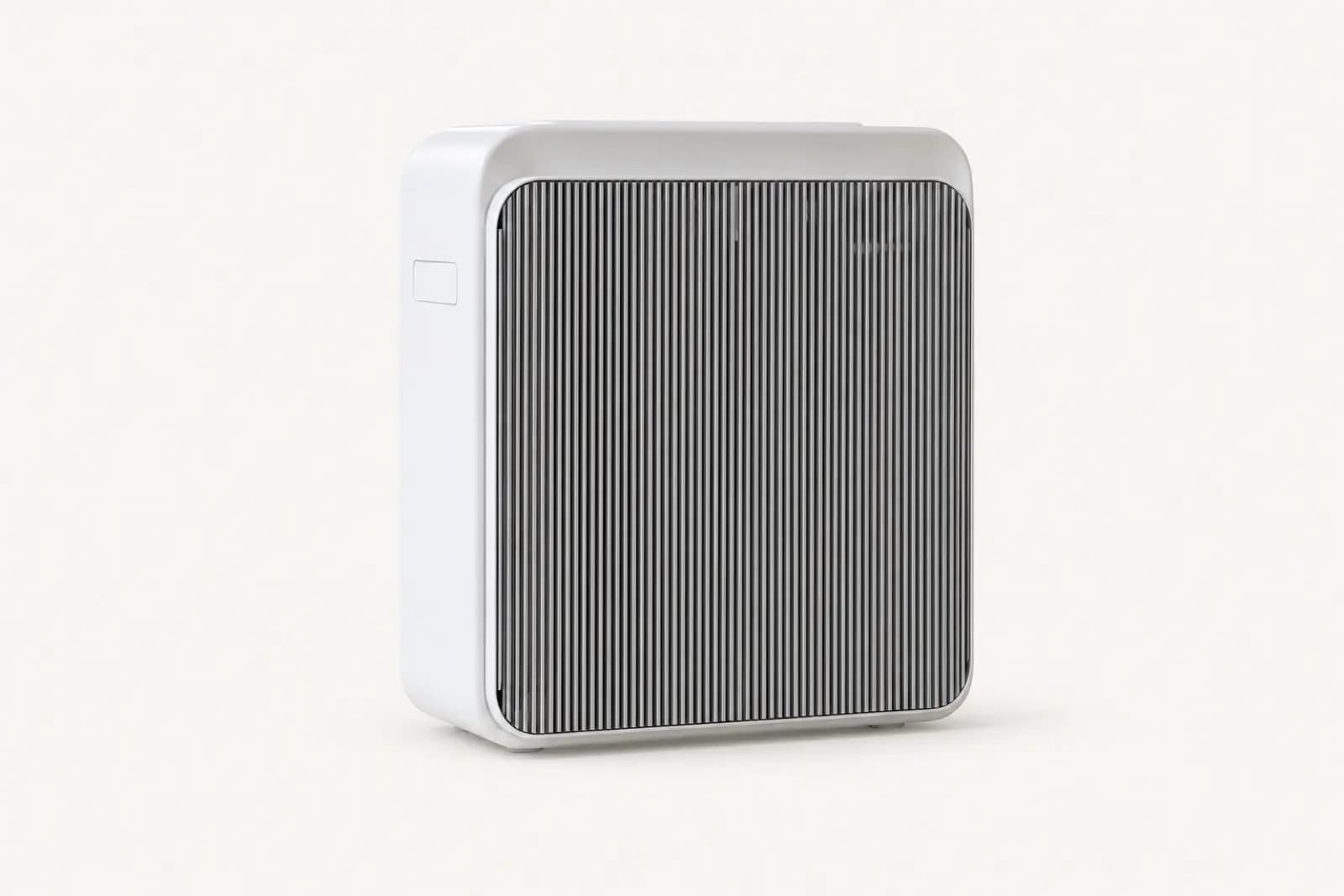
AirLab P80S circulates room air through washable particle collection, with sealed internal UV-C and sensors. Understand the measurements before comparing the numbers.
01 · Air
CADR · clean air delivered per hour
Clean Air Delivery Rate describes the volume of particle-cleaned air delivered over time. AirLab’s published smoke CADR is 441 m³/h.
Its published coverage is up to 62 m². Compare CADR for the same particle category, then consider ceiling height, layout, fan setting and ventilation. A coverage headline does not guarantee the same result in every room.
02 · Air
Electrostatic filtration · charge and collect
A washable pre-filter catches larger debris. AirLab’s CoreCharge™ stage electrically charges finer particles so they collect on its surfaces.
Routine upkeep is washing the pre-filter and collector, then fully drying them before reinstallation. There is no routine disposable filter purchase under normal use. Follow the manual rather than equating washable with maintenance-free.
03 · Air
UV-C · sealed internal hygiene
The UV-C module is enclosed inside AirLab and is intended to reduce microbial build-up on internal surfaces and parts.
Internal-module laboratory results are not whole-room disinfection results. Keep the housing closed and follow the manual; UV-C is not a substitute for particle collection, source control or ventilation.
04 · Air
PM2.5 · fine airborne particles
PM2.5 refers to particles with diameters of 2.5 micrometres or smaller. AirLab’s sensor reports conditions near the machine.
The reading helps you follow changes in local particle levels. It does not identify every particle’s composition or describe the air in every corner of your home.
05 · Air
Sensors · local signals, not a complete air test
AirLab combines PM2.5 and TVOC sensing. TVOC is a broad signal for volatile organic compounds, rather than identification of a particular gas.
Use trends alongside source control and appropriate ventilation. The display is not a comprehensive safety score. Published controlled-chamber and internal-module results have conditions and scopes that differ from normal room use.
Sources & documents
Follow the evidence.
General technology guidance, manufacturer specifications and exact product testing have different scopes.
Manufacturer specifications and controlled-test context.
Placement, operation, washing and drying instructions.