
Water Quality · Singapore
Water Dispenser vs Water Purifier: Functions, Costs and Installation
Compare hot and cold water, filtration, purchase or subscription costs, installation and upkeep for Singapore homes.
Written by
Velta Singapore Editorial Team
Updated
Reading time
About 5 minutes
How we research
Editorial policy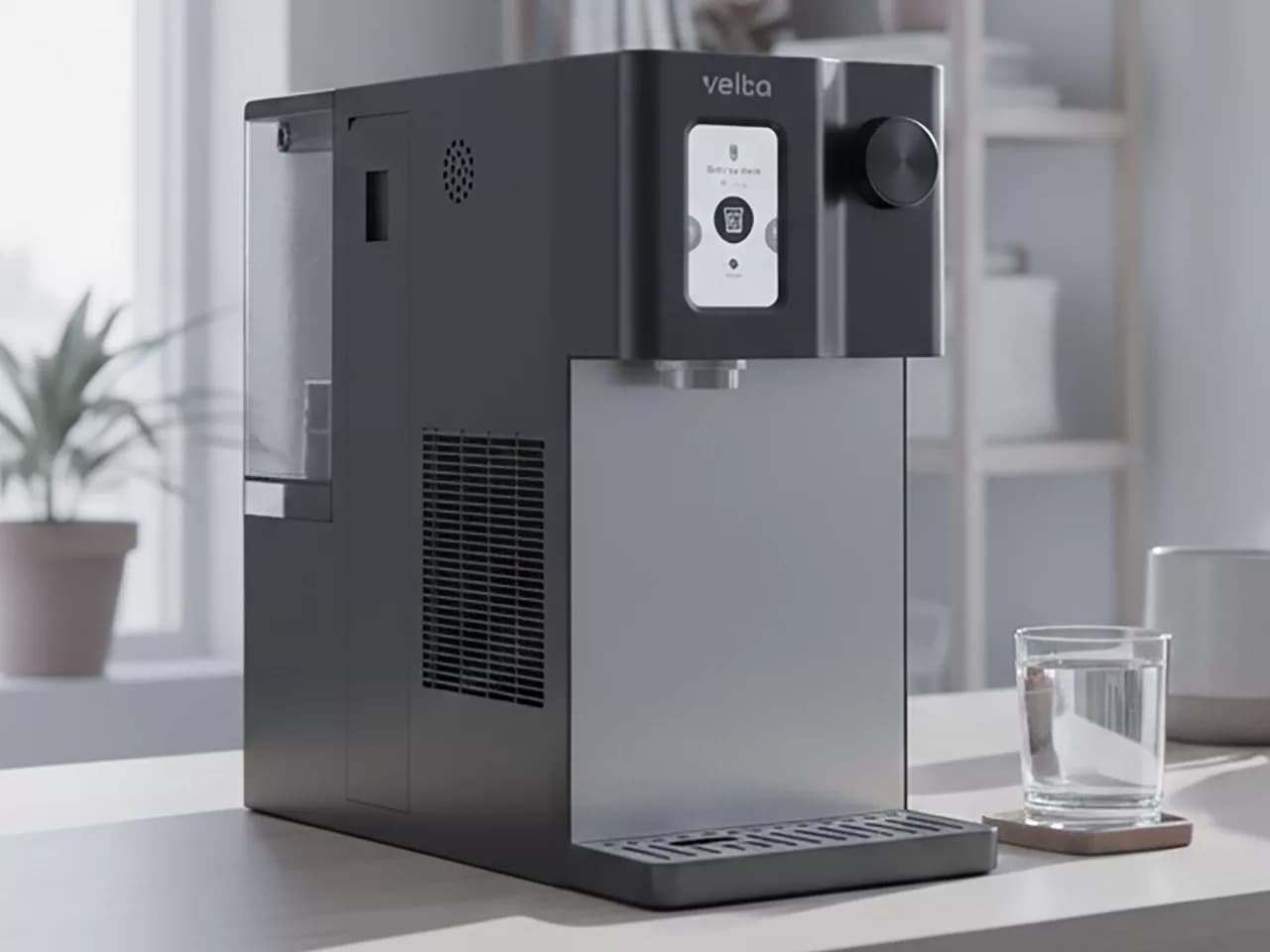
If you are comparing water dispensers and water purifiers, start with what you want from the tap. The product label is less useful than the answer.
Scroll to see the full table
| What you want | What to compare |
|---|---|
| Better taste or a particular filtration result | Water purifiers with test evidence for the exact model |
| Instant hot or chilled water | Point-of-use water dispensers; check whether filtration is included |
| Filtered water plus hot and cold dispensing | A dispenser with built-in filtration, or a purifier with temperature control |
| Filtered sparkling water | A purifier with built-in carbonation |
| More counter space | An under-sink purifier with a dedicated faucet |
In other words, a purifier treats water and a dispenser delivers it. One appliance can do both.
Why the Names Are Confusing
A water purifier contains a treatment stage such as activated carbon, ultrafiltration or reverse osmosis (our water filter comparison covers the full spread from pitcher filters to whole-home systems). It may sit under the sink, on the counter or at the faucet. Some purifiers dispense only ambient water; others also heat or chill it.
A water dispenser is defined by convenient delivery. It may pour ambient, hot or cold water from a bottle, refill tank or plumbed-in supply. Filtration is not guaranteed: a bottled dispenser may simply dispense the water supplied in the bottle, while a modern point-of-use dispenser often has a purifier inside.
This is why two products sold as “water dispensers” can be completely different purchases. One may be a basic bottle-and-tap stand. Another may be a plumbed-in RO purifier with temperature presets and a service contract.
The terminology is not consistent across brands such as Cuckoo, Coway, Wells, Hydroflux or Velta. Compare the exact model rather than assuming that every product in the same category performs the same jobs.
A Realistic Singapore Kitchen Example
Consider a household that fills bottles in the morning, boils a kettle several times a day and keeps chilled water in the fridge.
- If the only annoyance is kettle and fridge handling, a hot-and-cold dispenser solves it. Filtration may not be necessary.
- If the household prefers low-TDS RO water, the treatment system matters first. Hot and cold dispensing is an optional second requirement.
- If counter space is already tight, adding a large dispenser may solve one inconvenience while creating another. An under-sink purifier keeps the worktop clear, although it requires a suitable cabinet, water connection and faucet position.
- If the household buys sparkling water as well, a combined purifier and carbonator may replace several appliances—but it will cost far more than a standalone soda maker.
That sequence produces a better shortlist than beginning with brand names.
Five Things to Compare
1. The Treatment Result
Ask what the exact model is designed and tested to do.
- Activated carbon is commonly used for chlorine-related taste and odour. Other reduction claims depend on the cartridge and its evidence.
- Reverse osmosis (RO) reduces total dissolved solids and, where the complete system has been tested for them, specific named substances. It also produces a reject-water stream. The reverse osmosis explainer shows how Velta applies RO across its range.
- Ultrafiltration (UF) holds back particles down to its membrane rating but does not normally reduce most dissolved solids.
- UV treatment can inactivate susceptible microorganisms under stated operating conditions; it does not remove particles or dissolved material.
PUB says Singapore tap water is suitable for drinking directly without further filtration. So a purifier is a choice you make for taste, for low-TDS water, for hot, cold or sparkling on tap, or for a specific problem a test has found in your building, not a fix for unsafe public water.
2. The Water Modes You Will Use
Do not pay for a long list of temperatures if you only use ambient and boiling water. Check the actual preset temperatures, serving volume, recovery time and child lock rather than accepting “hot and cold” as a complete specification.
Sparkling water and hydrogen water are separate functions. Neither comes automatically with a normal dispenser or purifier.
3. The Installation
A plumbed-in countertop appliance needs a water inlet, a drain and a power point nearby. A refill-tank model needs no plumbing, but you fill it by hand and clean the tank. An under-sink model preserves counter space but uses cabinet space and needs a faucet position.
Measure the appliance and the space around it, not just the empty patch of worktop. Allow room to remove tanks, open lids and change filters.
4. The Full Cost
Compare the same ownership period for every option. Include:
- purchase price or the entire rental/subscription commitment;
- installation and removal charges;
- filter, membrane or CO2 replacements;
- scheduled servicing;
- early-termination terms; and
- whether you own or return the appliance at the end.
A low monthly figure can conceal a long contract. An outright purchase can look expensive until the same three- or five-year period is compared.
5. Maintenance and Local Support
Find out who changes the filters, how replacements are ordered, how quickly local service is available and what the warranty actually covers. The useful filter schedule is the one published for the exact cartridge and appliance, not a generic interval copied from another system.
Where the Velta Models Fit
Scroll to see the full table
| Household requirement | Velta format |
|---|---|
| Countertop RO with hot, cold and ambient water | HydroForm+ |
| Countertop RO with hot, chilled, ambient and sparkling water | HydroSpark+ |
| Ambient RO water without a countertop appliance | HydroView+, installed under the sink |
These are all water purifiers. HydroForm+ and HydroSpark+ also do the job most people expect of a hot-and-cold dispenser.
Hhuhu is different: it is a 3 L countertop hydrogen water machine that you fill with purified, distilled or RO water. It does not purify tap water, so it is not the answer if filtration is what you need.
If fizz is all you want, start with the Singapore sparkling-water-maker comparison. A standalone carbonator is much cheaper. If filtration is the priority, use the water-purifier selection guide to choose the treatment and installation before comparing hot, cold or sparkling extras.
The simplest rule is also the most useful: choose the water treatment you can justify, the water modes you will actually use and the installation your kitchen can take. Everything else is packaging.
Next step
Compare the products for your home.
Velta Singapore sells some of the products discussed in this article. Compare what they do, how they install and what they cost to run against the other products in the guide.
Velta prices are live from our Singapore store. Competitor prices, promotions and availability can change. Filters and any installation work add to the total cost over time.