
Water Purification · Singapore
Why Does the HydroSpark+ Have a Divider in the Tank?
The small divider inside your HydroSpark+ tank looks like it does nothing — but it's central to how the system recirculates water in tank mode instead of sending residual water down a drain.
Written by
Velta Singapore Editorial Team
Updated
Reading time
About 4 minutes
How we research
Editorial policy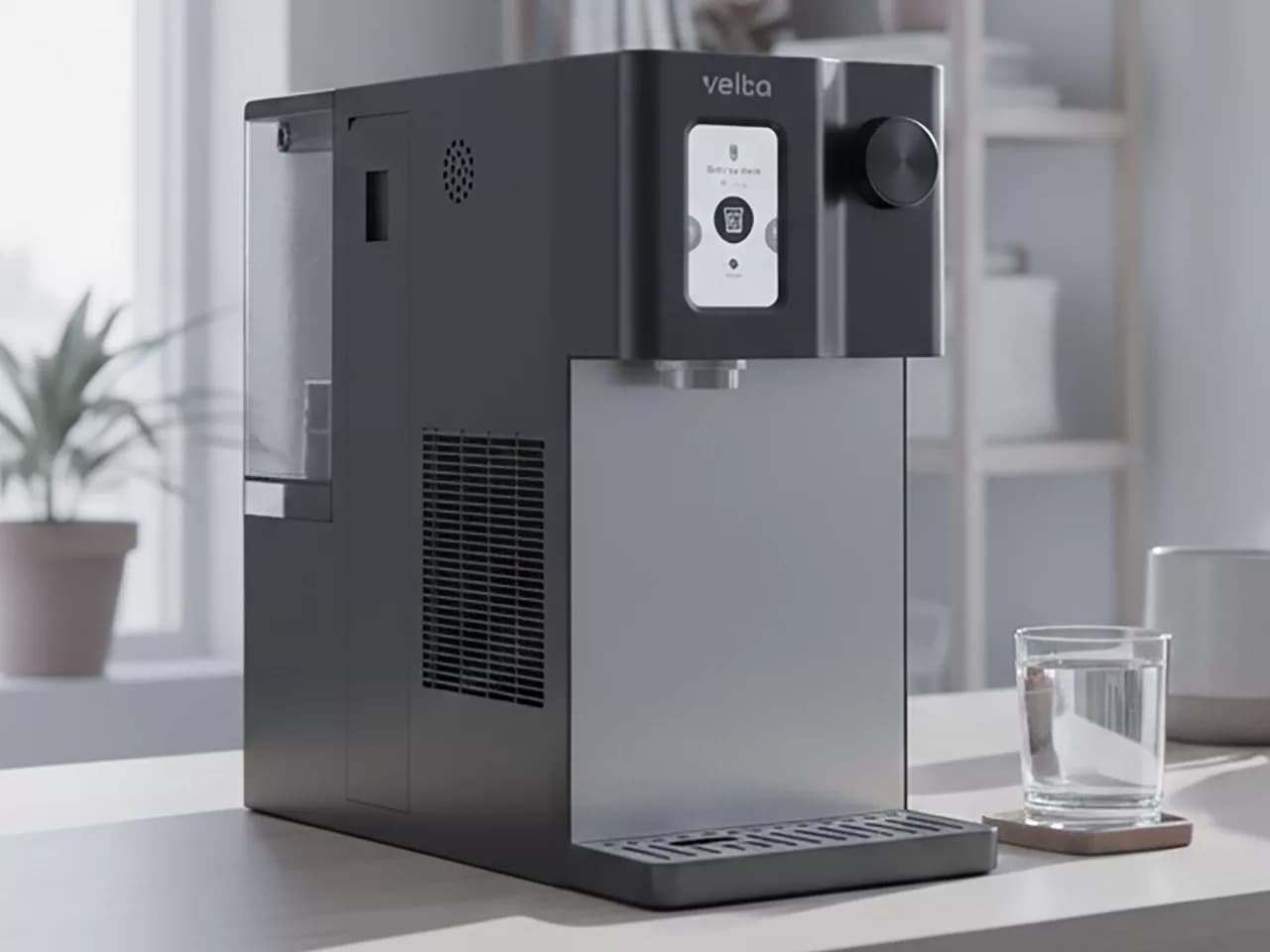
A small divider separates one side of the HydroSpark+ water tank. The larger side holds about 3 litres and the smaller side about 1 litre. At the 5-litre MAX line, water sits above the divider, so at first it just looks like one tank.
The divider only starts to matter once you have used some water.
A Quick Primer on How RO Filtration Works
Reverse osmosis works by pushing water through an extremely fine membrane (0.0001 µm). Pure water passes through. Dissolved solids, heavy metals, and other impurities get left behind.
RO filtration produces a reject-water stream by design. In a traditional system connected to plumbing, producing 1 litre of clean water can send 3 to 4 litres down the drain as waste. The exact amount depends on the system, the source water and the operating conditions.
How the HydroSpark+ Handles Residual Water in Tank Mode
HydroSpark+ sits on the counter, and in tank mode there is no drain to send water to. So the residual water goes back into the tank.
It goes back into the tank.
When the system filters water, two things happen at once:
- Clean water is dispensed from the spout.
- Residual water — what didn't pass through the membrane — is returned to the smaller side of the tank.
The residual water re-enters at the base of the smaller compartment. While the water level is above the divider, both sides remain connected and the residual water mixes back into the source water. The system draws from this water again during the next treatment cycle.
This is called recirculation. Instead of sending residual water to a drain, the system re-treats it, so far less water is thrown away than in a system plumbed to a drain. The manufacturer rates tank mode at about 4 litres of clean water for every 1 litre of residual water under its test conditions. In your kitchen it will vary with source water, temperature and how old the membrane is.
The membrane filters just as finely on every pass, including water that has already been round once. Recirculation does not change how well it filters; it just means less water goes down the sink.
When the Divider Begins to Matter
As you keep dispensing water, the level in the tank drops. Eventually, it reaches the top of the divider.
At this point, the two sides of the tank separate. But the smaller side is already full to the brim of the divider — and the system keeps returning residual water to it through the valve at the base. Since it's already full, new residual water displaces the cleaner water sitting above it, making it overflow back into the main tank. Recirculation continues, but the main side keeps dropping because clean water is being dispensed out faster than residual water is being returned.
When the main side runs empty, the system stops and tells you it's time to refill.
At that point, the smaller compartment holds about 1 litre of the most concentrated residual water from the filtration cycle. The divider keeps it away from the intake so the purifier never draws from it, and gives you a defined litre to pour away.
What to Do When It's Time to Refill
- Lift out the water tank.
- Pour away the remaining water (this is the residual water in the smaller compartment).
- Refill the entire tank with fresh tap water to the MAX line.
- Place it back in the unit.
There is nothing to set or check. The tank does the separating for you.
Why a Divider Instead of a Sensor?
A water-quality sensor might seem like an alternative to a physical divider.
The HydroSpark+ does have a TDS (Total Dissolved Solids) sensor built in — you can check your water quality readings anytime from the settings screen. But the system doesn't rely on it to decide when you should flush and refill. Sensors can drift over time, need calibration, and depend on firmware logic to interpret readings correctly. The divider takes a mechanical approach instead: it caps recirculation at roughly the 4:1 ratio described above, with the same real-world variation.
The divider puts a hard limit on recirculation, so the membrane is never asked to process the same water too many times. That helps it last longer.
Tank Cycle Summary
Scroll to see the full table
| Phase | What's happening |
|---|---|
| Tank full (above divider) | One body of water. System filters, dispenses clean water, returns residual water at the base of the smaller compartment — it all mixes freely. |
| Water drops to divider | Residual side is full and stays full — new residual water overflows back into the main side. Main side keeps dropping as clean water is dispensed out. |
| Main side empty | System stops and prompts you to refill. Pour away the remaining ~1L of residual water, refill with fresh tap water. |
The divider is a simple divider that does a surprisingly important job: it limits recirculation in tank mode. Empty the residual water when prompted, then refill the tank with fresh water.
Next step
Compare the products for your home.
Velta Singapore sells some of the products discussed in this article. Compare what they do, how they install and what they cost to run against the other products in the guide.
Velta prices are live from our Singapore store. Competitor prices, promotions and availability can change. Filters and any installation work add to the total cost over time.